
Banbury Cross history and the nursery rhyme
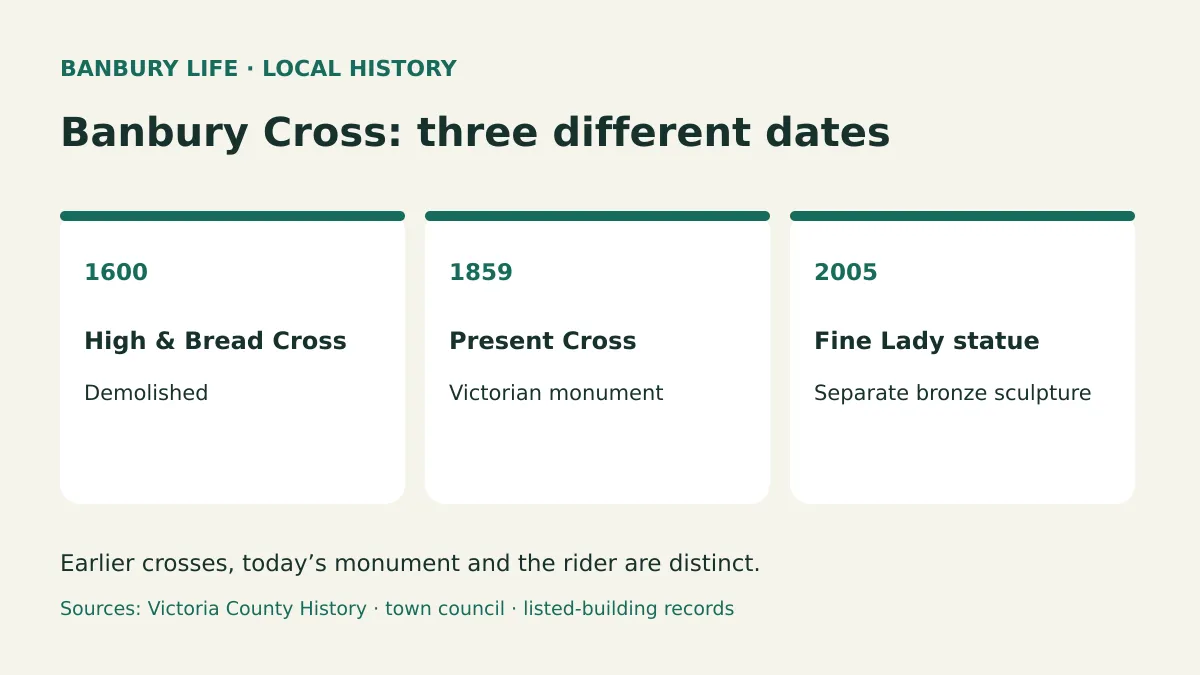
Banbury Cross history involves several different landmarks: medieval crosses in the old trading streets, the Victorian monument erected in 1859, and the separate Fine Lady statue unveiled in 2005. The nursery rhyme “Ride a cock-horse to Banbury Cross” also survives in different versions. You can explore the landmarks today without treating the rider’s identity, or the present Cross’s medieval ancestry, as settled history.
Which Banbury Cross was destroyed in 1600?
The Victoria County History records the High Cross and Bread Cross as demolished in 1600. It also describes a White Cross outside the western gate, but does not give that boundary stone the same documented demolition date. Its account is more precise than the familiar shorthand that “Banbury’s three crosses were destroyed”. Source: VCH, Banbury’s origins and growth.
| Earlier landmark | Where the county history places it | What the evidence says |
|---|---|---|
| High Cross, also called Market Cross | In or beside Market Place, probably at the southern end of Cornhill | Certainly described by John Leland around 1540; probably the stone cross in a 1478 will. A tall carved shaft stood above eight surrounding steps. Demolished in 1600. |
| Bread Cross | Junction of Butchers Row and High Street | A stone market cross with a slate roof, recorded in the 1441 survey; called Bread Cross from at least 1549, probably after the bakers’ stalls. Demolished in 1600. |
| White Cross | Outside Sugarford Gate, probably near the Bear Garden Road–Broughton Road junction | Named in the 1554 boundary description; called a “great stone” in 1606. VCH suggests it was a weathered ancient cross base or shaft. |
The High Cross was pulled down in the period of Banbury’s strong Puritan influence. That destruction belongs to 1600, not to the Civil War sieges more than forty years later. Our Banbury Castle history follows that separate wartime sequence.
The location matters, too. VCH finds no evidence of a medieval cross in Horse Fair, where the present monument stands. It suggests that the Victorian choice followed Alfred Beesley’s 1841 belief that the principal old cross had stood there. A familiar modern landmark need not occupy its predecessor’s site.
Why was the present Banbury Cross built in 1859?
The present Banbury Cross was erected in 1859 to celebrate the marriage of Queen Victoria’s eldest daughter, the Princess Royal, to Prince Frederick of Prussia. It is a Victorian commemorative monument, rather than surviving medieval masonry. Banbury Town Council’s Cross page explains the occasion and its heraldic decoration.
The three royal figures on the monument came later. The council dates the installation of statues of Queen Victoria, Edward VII and George V to 1914, commemorating George V’s 1911 coronation. They should not be confused with the much later horse-and-rider sculpture nearby.
Historic England records the Cross as Grade II*, under list entry 1199654. Listing protects the monument’s architectural and historic interest; it does not make it the cross seen by the rhyme’s original singer.
How old is “Ride a cock-horse to Banbury Cross”?
The opening line is older in print than the familiar fine-lady verse. A version in Tommy Thumb’s Pretty Song Book, around 1744, concerns what Tommy can buy: a white loaf, a white cake and an apple pie. A surviving 1784 version in Gammer Gurton’s Garland has an “old woman”, rather than the modern “fine lady”.
The recorded-version chronology is summarised in the rhyme’s account citing Iona and Peter Opie’s Oxford Dictionary of Nursery Rhymes, pages 65–67. It also identifies an American 1788 printing with the fine lady. These are dates of recorded texts, not proof of the year the rhyme was composed.
The familiar verse, also reproduced by the town council, runs:
Ride a cock horse to Banbury Cross
To see a fine lady upon a white horse
With rings on her fingers and bells on her toes
She shall have music wherever she goes
Another version sends little Johnny to buy a galloping horse. The changing shopping, rider and horse verses show how much the rhyme could vary in print and performance. In a BBC interview with Banbury Museum’s Simon Townsend, the museum director connects its preservation with inexpensive chapbooks and Banbury’s Rusher family of publishers.
A cock-horse can mean a pretend horse or an adult’s knee used for a bouncing game. Oliver Tearle’s literary account, drawing on the Opies, notes that this sense is recorded as early as 1540. The expression has other horse-related meanings, so the words alone do not establish a particular journey by a real rider.
Who was the fine lady?
Celia Fiennes, Elizabeth I and Lady Godiva have all been proposed. None is a securely identified original subject of the rhyme.
- Celia Fiennes: her travels and family connection with Broughton Castle make her an appealing local candidate. The proposed “Fiennes lady” wordplay remains a theory, not a documented identification.
- Elizabeth I: a royal rider is plausible imagery, but the proposal lacks evidence tying the surviving verse to a specific visit.
- Lady Godiva: horse-riding imagery and later Coventry versions have encouraged the association. They do not prove that the Banbury verse began as her story.
Tearle sets out these interpretations; the museum interview likewise leaves the identity open. The early “old woman” variants are a good reason to resist reading every modern detail as a coded biography.
The Fine Lady statue is a separate 2005 landmark
The bronze Fine Lady statue was unveiled by the Princess Royal on 27 April 2005. Banbury Town Council describes its rider as the Queen of the May, with spring flowers, butterflies, bells and a frog among its details. Artcycle designed it; Denise Dutton sculpted the horse, modelled on a Welsh Cob. Source: council’s Fine Lady statue page.
That is a modern artistic interpretation of the rhyme, not a discovery of the historical woman’s identity. Look for the spring motifs when you visit: they give you something specific to notice beyond the horse’s outline.
Explore the Cross and the older trading streets
Find the present Cross at the top of High Street, where Horse Fair, South Bar and West Bar Street meet. View it from the surrounding pavements: it stands within a traffic roundabout, so do not step into the carriageway for a closer look. The Fine Lady is a separate nearby stop.
Continue towards High Street and Butchers Row to relate the Bread Cross to its former trading location, then Market Place and Cornhill for the High Cross’s probable site. These are suggested landmarks, not a measured walking route or surviving crosses to enter.
For the wider story, choose a chapter from our Banbury history collection. Sources reviewed on 23 November 2026. Cover: original Banbury Life timeline based on the linked county history and council records.