Banbury’s historic pubs: Swan and Reindeer
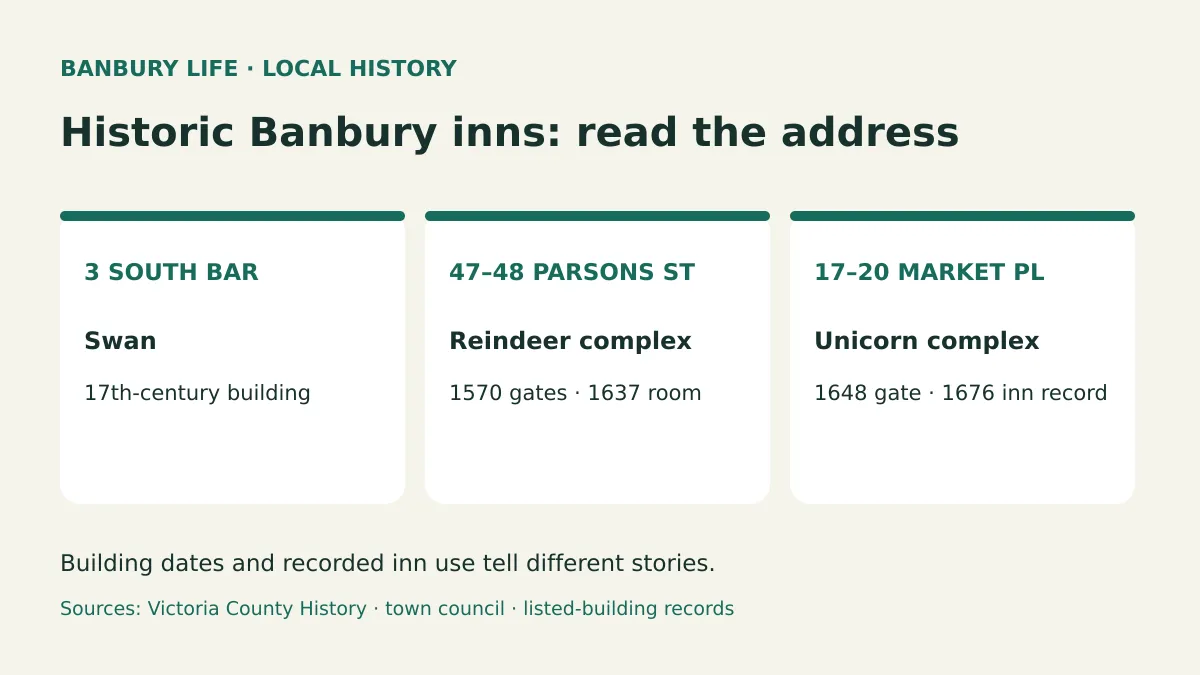
Banbury’s historic pubs include the Swan at 3 South Bar Street and Ye Olde Reine Deer Inn at 47 Parsons Street, part of an older complex spanning numbers 47–48. Their buildings preserve different periods of construction, and a building date is not automatically the date an inn began trading. The former Unicorn complex around 17–20 Market Place adds a well-documented courtyard-inn story without requiring an “oldest pub” claim.
Which Swan and Reindeer buildings are we talking about?
Names in old directories and listing records can outlive a landlord, business or shop. Use the address as well as the name when comparing them.
| Historic place | Building evidence | Recorded inn use | How to approach it today |
|---|---|---|---|
| Swan, 3 South Bar Street | Grade II; seventeenth-century ironstone building with later alterations | PubWiki transcribes an 1842–44 directory entry for the Swan and 1850s entries as White Swan | CAMRA currently lists an operating pub at this address; contact it for your visit. |
| Reindeer complex, 47–48 Parsons Street | Grade II*; early/mid-sixteenth-century core, 1570 gates and range, additions dated 1624 and 1637 | VCH regards an inn from 1570 as likely but not proved for this building before 1706; it also records earlier Reindeer references | The current inn’s own site gives 47 Parsons Street. Number 48 belongs to the historic complex but should not be assumed to be part of the pub’s visitor space. |
| Unicorn complex, 17–20 Market Place | Mainly mid-seventeenth-century courtyard buildings; gateway dated 1648 | First positive evidence of the Unicorn on this site in 1676, according to VCH | View the Market Place frontage from public space; the historic complex is broader than the building numbered 20. |
Sources: VCH, Banbury buildings, the Swan listing text, Reindeer listing text, Swan directory transcriptions, CAMRA’s Swan page and the Reine Deer’s own website.
The Swan: a seventeenth-century building, not a proved opening date
Historic England’s Swan Inn record, 1200446, identifies number 3 on the east side of South Bar Street. Its description dates the building to the seventeenth century, with later changes, including replacement of mullioned windows by casements. The transcription linked above makes the description readable alongside the official record.
Look at the two projecting, gabled bay windows flanking the entrance. The listing identifies surviving fragments of stone mullions and hood moulds, alongside inserted windows. They are useful evidence of an altered old building, rather than a façade unchanged since construction.
The documentary trading evidence has another timescale. PubWiki’s compilation transcribes William Randle at the Swan in an 1842–44 Pigot’s directory, and Eliza Randle at the White Swan in 1852 and 1854. Those are attributed directory transcriptions, not a newly established seventeenth-century opening date. The White Swan entries refer here to the South Bar premises, not automatically to any other inn with a similar name.
CAMRA currently describes a single-room pub with live music and televised sport at 3 South Bar, OX16 9AA. For a present-day visit, check its listing and contact details, or call 01295 262100. Its current operation and its historic fabric are both worth knowing; neither proves uninterrupted trading from the building’s earliest date.
The Reindeer: what the 1570 gates establish
The Reindeer’s carved gates name John and Joan Knight and David Horn and carry the date 1570. VCH describes an early- or mid-sixteenth-century L-shaped western core, followed by an eastern range, probably from 1570, with distinctive star-patterned timber framing.
The full historic property encompassed 47 and 48 Parsons Street. VCH says the eastern part was divided off as a house after William Howes bought the property in 1706, and finally sold separately in 1795. The later listing calls number 48 Ann Elizabeth Health Foods, and notes an earlier listing name, Reindeer Hotel, for number 47. These labels describe the property at different times; they are not current business recommendations.
The official combined listing, 1369571, dates additions to 1570, 1624 and 1637. Its readable transcription distinguishes number 47’s core and rear additions from number 48 and the carriage entrance.
VCH’s warning is important: an inn operating here from 1570 is strongly suggested by the architecture and limited documents, but not proved for the building before 1706. It records a 1664 rent reference to the “Reindeer”, which need not mean an inn, and a late-seventeenth-century landlord, Thomas Sutton, who died in 1685. These pieces support a developing history; they do not justify presenting 1570 as an independently verified start of uninterrupted pub trading.
What is documented about the Globe Room?
The Globe Room is a rear addition dated 1637, built to a notably higher architectural standard than much local domestic work. VCH suggests that its elaborate panelling, decorated plaster ceiling and large window may have helped attract prosperous travellers. The origin of the room’s name is unknown in that account.
Its interior has its own history of removal and recovery. Banbury Historical Society’s November 1964 Cake & Cockhorse issue brings together Michael Laithwaite’s building study, Barrie Trinder’s account of the room’s reputation, C. F. C. Beeson’s antique-trade research and J. S. W. Gibson’s report on recovering the panels.
Those studies trace the room’s sale and removal in 1912 and the discovery of the panels in 1964. The later listing describes seventeenth-century panelling and an interior porch, and records plaster casts of the ceiling at the Victoria and Albert Museum. An old room can contain historic material while also having undergone dismantling, recovery and restoration. It should not be described as a complete untouched Civil War interior.
Did Oliver Cromwell or Prince Rupert use the Globe Room?
Stories connect the room with Oliver Cromwell and Prince Rupert. They are traditions, not securely documented visits in the research used here. Trinder’s 1964 study describes their popularity and reports that William Potts had acknowledged the inadequate basis for some of the associations.
The present pub uses Cromwell stories in its introduction. That establishes a current association in the pub’s storytelling, not proof that Cromwell planned a battle there. Its Globe Room page also repeats a tunnel belief; our underground history article explains why such connections need physical evidence. The room’s documented craftsmanship is substantial without attaching an unsupported royal visit or military headquarters claim.
Archaeology reveals a kitchen older than the gates
Giles Dawkes’s 2015 Oxoniensia article, A Late-Medieval Kitchen in Parson’s Street, Banbury, reports excavation behind the Reindeer. A substantial fifteenth-century masonry kitchen had ovens and occupation deposits; it was demolished by the late sixteenth century.
This is evidence for activity on the site before the 1570 gate date, not proof of a fifteenth-century public house. The article also reports earlier structural elements observed during the television investigation, while noting that a report on that building work was never produced. It is a reason to distinguish the site’s history from the dating of the visible ranges.
The Unicorn: a larger courtyard than number 20
VCH describes the Unicorn as a probably purpose-built, mainly mid-seventeenth-century complex, with 1648 carved over its gateway. The first positive inn reference on this site is 1676. As with the Reindeer, the carved construction date and documentary inn date answer different questions.
Its front range is 17–19 Market Place, while number 20, historically known as the Unicorn, lies on the north side of the courtyard behind the adjoining frontage. The historical inn therefore cannot be reduced to a single modern doorway.
A deed from 1807 lists kitchens, a bar, cellar, brewhouse, dining or warehouse space, stables and a printing office or cheese room. An earlier deed placed printer John Cheney in the printing office in 1780. Source: VCH’s Unicorn account. The courtyard served more than refreshments: it linked accommodation, transport, storage, brewing and printing.
Plan a lawful present-day look
- Swan: see the South Bar frontage from the pavement. For opening, music or access questions, use CAMRA’s linked contact details.
- Reine Deer: the current venue gives 47 Parsons Street, OX16 5NA, telephone 01295 270972. Its website lists Monday–Saturday 11am–11pm and Sunday noon–10pm, with food daily noon–9pm. Check the venue before travelling or booking; ask about Globe Room availability and access if that is your reason for visiting.
- Unicorn complex: study the Market Place frontage from public space. This historical guide does not offer entry to its courtyard, cellars or other premises.
“South Bar” in the Swan’s address is a street name inherited from a gateway. For that different story, read Banbury’s historic bars and gates. Our Banbury history collection links all the chapters.
Sources and present-day visitor information reviewed on 23 November 2026. Historic England pages may require a browser security check; the linked independent transcriptions reproduce the listing descriptions. Cover: original Banbury Life address-and-date diagram.